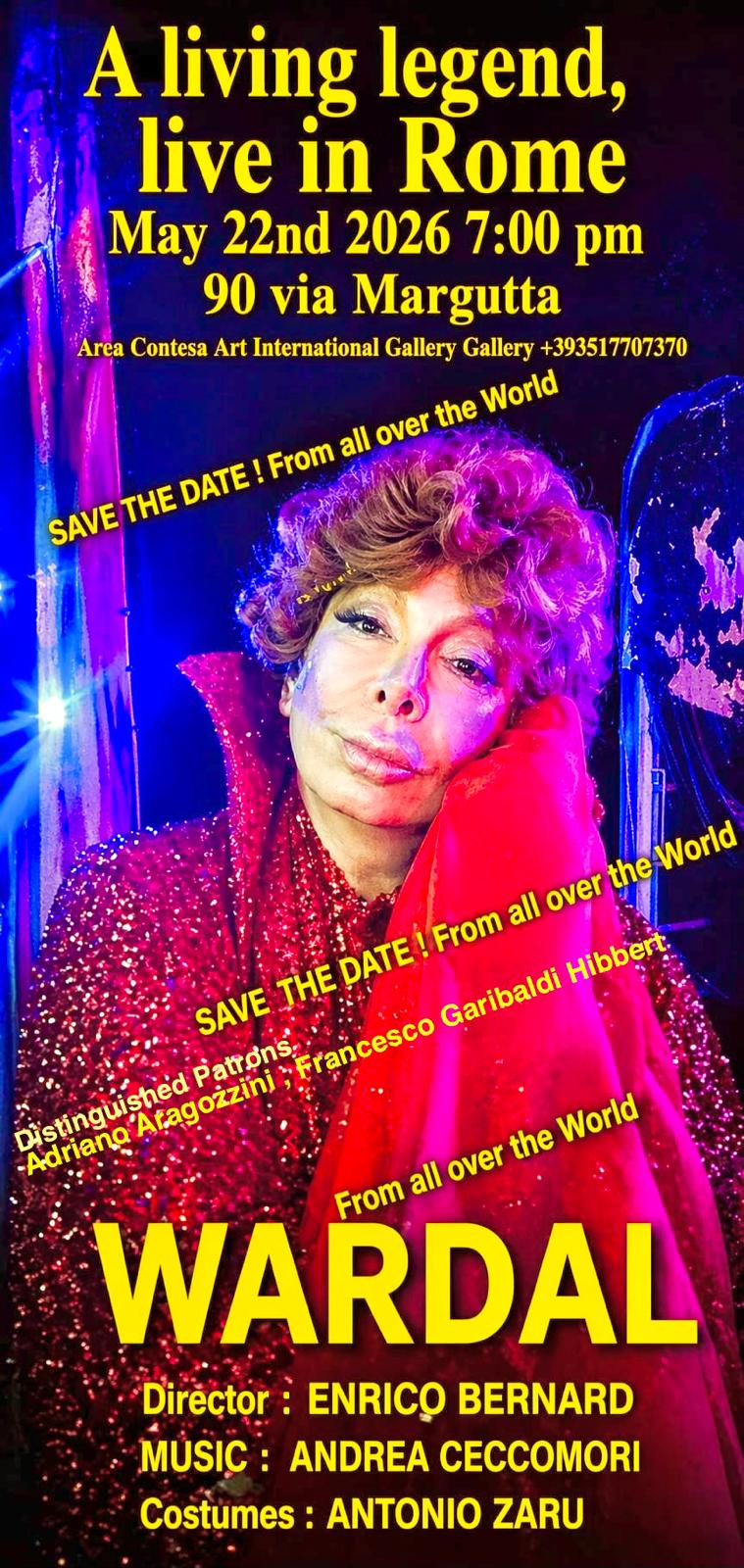

WARDAL: A Living Legend—Live in Rome on May 22nd at Via Margutta, 90. The Icon brings the Supreme Poet, Dante Alighieri, back to Life. Guests from around the globe.
الإثنين 27-04-2026 02:02
WARDAL: A Living Legend—Live in Rome on May 22nd at Via Margutta, 90.
The Icon brings the Supreme Poet, Dante Alighieri, back to Life.
Guests from around the globe.
By Ibrahim Shehata
On May 22, 2026, in the historic center of Rome—specifically on the legendary Via Margutta at number 90, at Area Contesa Arte Design International Gallery run by Tina and Teresa Zurlo—special guests from all over the world will gather for a truly unique event.
By its very nature, this occasion has already become the talk of the town everywhere, even before it has taken place.
It is an event centered on a jux : supreme poet Dante Alighieri (1265–1321), and Count Federico di Wardal—a living legend and international superstar.
This truly unusual occurrence might be classified as sensational; yet, upon closer inspection, one realizes that both Dante and Wardal belong to a shared realm of intellectual nobility—even if they do not share a historical equivalence.
Dante embodies the transfiguration of experience into poetry, while Count Federico di Wardal embodies not only the staging of identity as a cultural myth, but also the very identity of that staging itself—perceiving it as a “visual” form of humanity.
In the live performance that Wardal will present—constantly addressing Dante throughout—there is a line asserting that while Dante belongs to the realm of poetry, Wardal is theater incarnate.
This premise sparks a series of comparisons: on one side stands Dante—the poet of total vision, the author who transforms personal, political, and moral experiences into a grand, universal fresco; on the other stand the cultural revolutions of the modern era, for which Wardal serves as a standard-bearer, alongside his “friends” Pier Paolo Pasolini and the poet Dario Bellezza.
Yet, in both Dante and Wardal, one finds the courage—and the struggle—to drive change relative to their respective eras, embracing the evolution of thought and progress, while always remaining grounded in profound honesty and truth.
Dante and Wardal can be interpreted as figures defined by a profound theatricality of identity—by an intimate relationship with the public representation of the self.
And so, Wardal makes his spectacular entrance from a flame-red automobile, clad in a long, trailing tunic of inferno-red sequins—a creation by fashion designer Antonio Zaru—performing under the direction of the illustrious Enrico Bernard and immersed in the music of the great flutist Andrea Ceccomori.
With the magnetism and power of a pagan god, Wardal delivers a brief performance that traverses the pathos of the most harrowing Greek tragedy.
The undisputed godmother of the event is the great actress Adriana Russo, while the performance’s distinguished godfathers are Francesco Garibaldi Hibbert—a descendant of the “Hero of Two Worlds,” linked to Wardal through films and globally acclaimed events celebrating the value of freedom—and Adriano Aragozzini. A legendary impresario who managed icons such as Tina Turner and Domenico Modugno, and the mythical patron of the Sanremo Festival, Aragozzini represents for Wardal the very epitome of artistic patronage.
Yet another event—among the many endeavors by Wardal that continue to astonish the world—is the imminent completion of the complex editing process for the feature film Ancient Taste of Death: The Sinister Legend of Wardal. Directed by the innovative and magnetic Antonello Altamura, the film is already being hailed as a unique thriller within its genre.
It is a story that seizes the imagination; appearing at first to be entirely a work of fiction—one that explores the various dimensions of human existence—it ultimately leaves the audience with the lingering, powerful doubt that it might, in fact, be true. In doing so, the film itself seems to take on human form—much like in classical myth, where the goddess Aphrodite breathes life into the statue sculpted by Pygmalion.
For this very reason, Wardal is regarded as a living legend: for every event, every theatrical production, and every cinematic work in which this divo participates invariably penetrates the collective imagination. Amidst the flurry of news surrounding Wardal, there is a new cinematic project titled Al Maza—directed by one of the greatest masters of art cinema, Sherif El-Azma—in which Wardal is portrayed as the quintessential phoenix: a being that regenerates itself from its own ashes. Yet, in the case of Al Maza, Wardal need not die to be reborn; rather, he regenerates himself while still alive—reincarnating within his own lifetime and, in doing so, transcending the very boundaries of death!
How could a film such as this fail to become legendary?
And finally, there is yet another irresistible film in the pipeline for Wardal: SHEMSU-HOR, directed by Andrea Marfori. It depicts a cosmic game of chess played by deities who determine Wardal’s fate—a fate which he, much like his ancestress Cleopatra VII, ultimately defies by taking his own life and bringing down the curtain on his existence, only to subsequently reincarnate and complete the very mission that destiny had thwarted in his previous life.
Indeed, every project in which Wardal is immersed serves to spark profound reflections on the nature of human existence.